Birdwatching has been something I've enjoyed for a long while and the American Robin has aways been one of my personal favorites. As Spring fast approaches it brings back memories  of seeing the first robin of the season. When we were still living in central Illinois I remember that the Winters always seemed so long and how exciting it was to see the first robin which indicated that spring had finally arrived. :) After moving to the South I was delighted to find that though the robins don't arrive in Spring, (our winters are mild anyway) we have them in the Winter. For the past few months we have enjoyed having the Robins here, one time I counted more then 50 robins in our front yard at one time! I have not seen any for a few weeks, so for those of you who live up North they are probably on their way! :) Below is a little information about Robins that I found interesting.
A Little about the American Robin:
The American Robin is a migratory songbird of the thrush family. It is widely distributed throughout North America, wintering south of Canada from Florida to

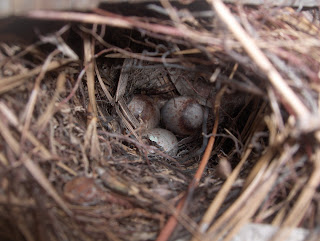
central Mexico and along the Pacific Coast. It has seven subspecies, but only T. m. confinis in the southwest is particularly distinctive, with pale gray-brown underparts. It is the state bird of Connecticut, Michigan, and The American Robin is active mostly during the day and assembles in large flocks at night. Its diet consists of invertebrates (such as beetle grubs and caterpillars), fruits and berries. It is one of the first bird species to lay eggs, beginning to breed shortly after returning to its summer range from its winter range. Its nest consists of long coarse grass, twigs, paper, and feathers, and is smeared with mud and often cushioned with grass or other soft materials. American Robin nest
-From Wikipedia, the free encyclopedia
Song:A musical whistled phrase,

"cheerily, cheer up, cheer up, cheerily, cheer up."
Call note a sharp "chup."
Descriptionlarge thrush.
Back and wings gray.
Underparts red.
Dark head with white eye crescents.
Size: 20-28 cm (8-11 in)
Wingspan: 31-40 cm (12-16 in)
Weight: 77 g (2.72 ounces)
And God said, Let the waters bring forth abundantly the moving creature that hath life,
and fowl that may fly above the earth in the open firmament of heaven. Genesis 1:20

 The mom and dad birds. They were both protective of the nest and would fly quite close to me. You can see the male is a lot darker then the female.
 The first time I found the nest it had four beautiful blue colored eggs in it. I love robins:).
 A few days later this little fellow had hatched.
  Then there were two of them. The other two eggs never did hatch.
 The next time I went down to look there was a huge difference; one of the babies had already flown and this guy was ready to go as well.
  And finally, the empty nest. It was fun watching for a few weeks:).


 Right as I was taking this picture the other owl flew away and just missed being in the shot.


 This is the second
 This
This